Are you compromising in your relationship — or compromising yourself?
The Dignity Compass™ helps you slow down, understand your patterns, define your dignity lines and make clearer relationship decisions without abandoning yourself.
You don't have to decide whether to stay or leave today.
First, learn to hear yourself clearly.

Sometimes the hardest part isn't knowing something feels wrong.
Sometimes the hardest part is knowing whether you're being loving… or losing yourself.
You may have become very good at adjusting. You understand their stress. You understand their circumstances. You keep the peace. You forgive. You give another chance. You explain their behaviour.
And slowly, the question changes from “What do I need?” to “What do I need to do so they are okay?”
The Dignity Compass™ was created for that moment. Not to make the decision for you. But to help you reconnect with your own ability to think, feel, question and choose.
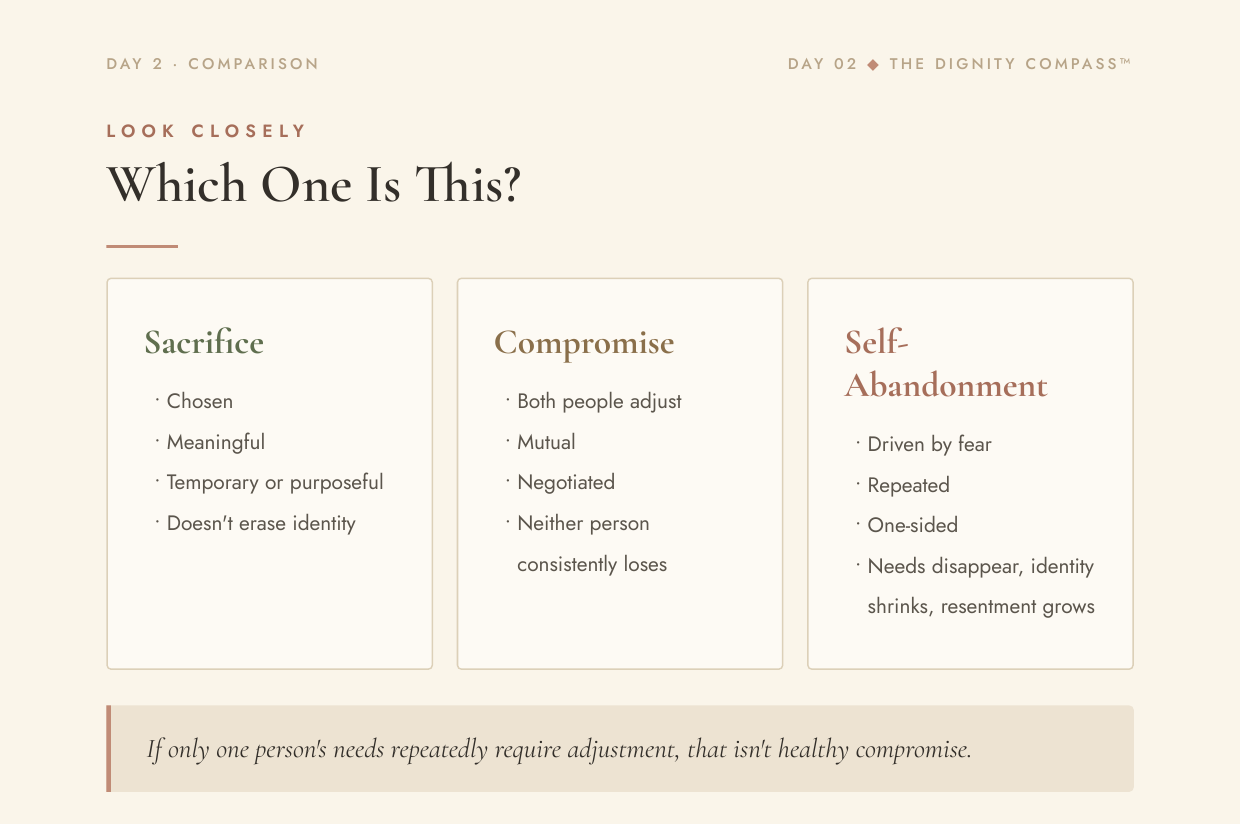
There is a difference between sacrifice and self-abandonment.
Self-Sacrifice
“I am choosing to give something because it matters to me, the relationship or the situation.”
- Chosen freely
- Meaningful
- Temporary or purposeful
- You still recognise yourself
Compromise
“Both people adjust.”
- Mutual
- Negotiated
- Both people matter
- Neither person consistently loses
Self-Abandonment
“I am repeatedly giving up something essential about myself because I am afraid not to.”
- Driven by fear
- Repeated, one-sided
- Needs disappear
- Identity shrinks, resentment grows
If only one person's needs repeatedly require adjustment, that isn't healthy compromise.
A 7-day journey back to clearer thinking
See Clearly Before You Decide
Learn to separate fact, interpretation, feeling and fear, using the workbook's 4-column clarity approach.
Sacrifice or Self-Abandonment?
Explore whether what you're calling “adjustment” is actually a conscious choice or a fear response.
Why Do I Keep Saying Yes?
Explore people-pleasing patterns and what you may be trying to prevent by saying yes — and meet the 10-Second Dignity Pause™.
Your Dignity Line
Define what's Green (flexible), Yellow (important) and Red (non-negotiable) — then understand boundary versus control.
The Regulated Decision
Before asking “what should I do?”, ask “what state am I deciding from?” — calm, activated, shut down, confused, angry, afraid or numb.
Say What You Mean
Learn to express what happened, what you feel, what you need, and what you'll do if the boundary isn't respected.
The Dignity Decision
Use the Clarity Matrix, the D.A.T.A.C.T. Decision Filter™ and the One-Year Mirror to ask not just “should I stay or leave?” but “what is true right now, and what do I need?”
This isn't just an ebook. It's a workbook you work through.
The Dignity Compass™
Seven questions to return to, whenever a decision feels too heavy to think through in one breath.
The 10-Second Dignity Pause™
Plus My People-Pleasing Map, Boundary or Control, the Clarity Matrix and the D.A.T.A.C.T. Decision Filter™ — see them all inside the workbook.
Real pages from the actual workbook
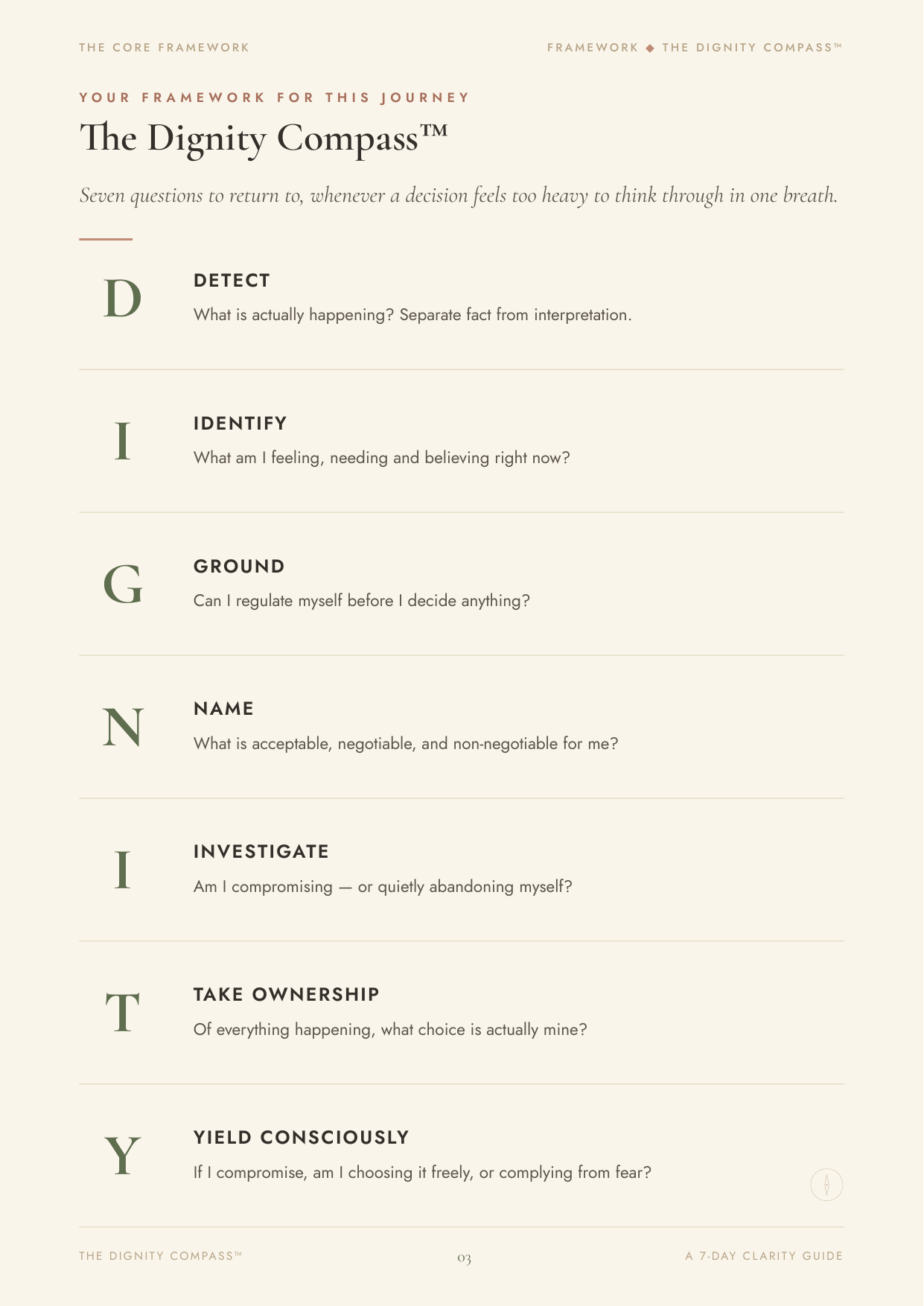
Plus the Dignity Pause, Your Dignity Line, the Clarity Matrix and the Decision Filter — see them all inside the workbook.
You'll have something more valuable than another opinion.
You will have a structured space to explore:
- ✓What is actually happening
- ✓What you are feeling, and what you need
- ✓What you keep tolerating
- ✓Where people-pleasing may be shaping your choices
- ✓What your boundaries are — and what's within your control
- ✓What patterns you're seeing, and your next smallest step
The goal isn't to give you the answer.
It's to help you trust yourself enough to ask better questions.
This workbook may be for you if…
- ✓You keep second-guessing yourself
- ✓You struggle to tell compromise from self-abandonment
- ✓You say yes when you really want to say no
- ✓You feel guilty when someone is disappointed with you
- ✓You keep adjusting to keep the peace
- ✓You want boundaries without controlling another person
- ✓You're facing a decision but don't want someone else making it for you
What this workbook will not do
- —Diagnose your partner
- —Tell you whether to stay or leave
- —Replace therapy or professional support
- —Give you a magical solution to a complex relationship
- —Decide your future for you
It gives you a structured space to understand your own experience and choices.

Ayesha Ali
Counselling Psychologist | Women's Transition & Clarity Coach
Ayesha works with women navigating career changes, relationship transitions and difficult dynamics, drawing on nervous-system-informed and cognitive-behavioural approaches to help them build clarity and resilience.
The Dignity Compass™ grew out of that work — the recurring moment when a woman knows something feels off, but can't yet tell whether she's being loving or losing herself. This workbook doesn't hand her an answer. It gives her a way to think it through.
A week of clarity can begin with one honest question.
Frequently Asked Questions
Is this therapy?+
No. It is a self-reflection and decision-clarity workbook, not a form of therapy.
Will it tell me whether I should leave my relationship?+
No. The workbook deliberately does not make that decision for you.
Is this only for women experiencing abuse?+
No. It is designed for women navigating confusing or unhealthy relationship dynamics, self-sacrifice, people-pleasing, boundary difficulties and loss of self.
How long does it take?+
Each day is designed to take approximately 20–30 minutes.
Can I print it?+
Yes. It is designed as an A4 workbook and can be printed or used digitally.
What format do I receive?+
A downloadable PDF workbook.
What if I don't know what I want to do about my relationship?+
That is completely okay. The workbook is specifically designed to help you explore your situation before making a major decision.
Is it suitable if I am experiencing immediate danger?+
The workbook is not a substitute for emergency or professional support. If you are experiencing threats, physical violence, coercive control, stalking, sexual coercion or immediate danger, prioritise safety and seek appropriate local support.
You don't have to figure out your entire future today.
Maybe your next step isn't a final decision. Maybe it's a question. A boundary. A pause. An honest conversation. A moment where you finally ask yourself what you need.
The Dignity Compass™ gives you seven days to slow down and listen.
Not to someone else's answer. To your own.